Church kneelers at
Winchester Cathedral
Winchester, Hampshire
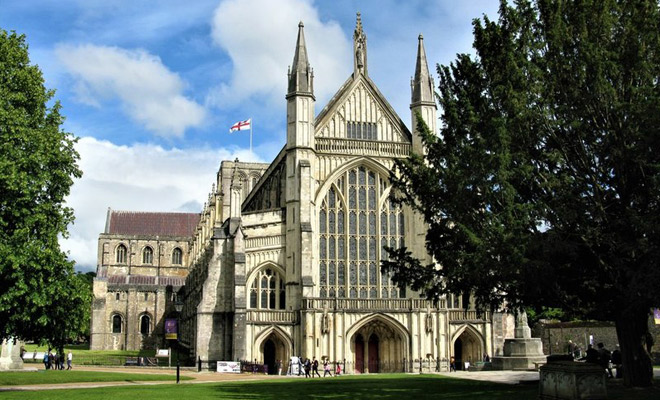
Winchester Cathedral in Hampshire is one of the largest cathedrals in Europe, with the greatest overall length of any Gothic cathedral.
Sybil Blunt, during the 1930s, designed its pictorial choir stall cushions and kneelers focusing on Winchester’s history. Her example triggered an explosion of folk art church kneelers across the country as congregations designed their own kneelers illustrating their local history, their local environments and their local buildings.
Sybil Blunt was supported by the formidable Louisa Pesel who trained and supervised the Winchester stitchers. Louisa Pesel herself preferred traditional geometric designs and repetitive designs to pictorial ones. It was her designs for the chapel in the Bishop’s Palace that prompted the Winchester Dean to invite her to design canvaswork for the Cathedral chancel.
Louisa Pesel said that she would bring in her ‘assistant’, Sybil Blunt. Sybil Blunt was an innovator and proved to be the outstanding textile designer of the day. Twentieth century folk art in this country is her legacy.
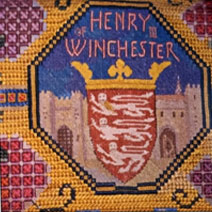
The first three images are medallions taken from the long seat cushions in the Quire: King Alfred, King Henry III and Bishop William of Wykeham.
A long seat cushion follows, showing symbols of the regiments that have been based at Winchester. On its right the medallion features William Walker – known as Diver Bill. Serious cracks had developed in the Cathedral in 1905 as rising groundwater turned its peaty foundations to slurry. Diver Bill was recruited to build a solid foundation. Over five years he worked in six metres of densely muddied water shifting 25,800 bags of concrete, 114,900 concrete blocks and 900,000 bricks. Finally the peaty groundwater was pumped out leaving the Cathedral secure on its new foundations.
The next seat cushion shows the prosperous local agricultural economy that gave the medieval Cathedral its economic base. On its right the medallion records Bishop Woodlock who installed the leafy dragons across the choir stalls, carved by William Lingwoood.
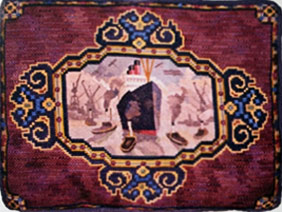
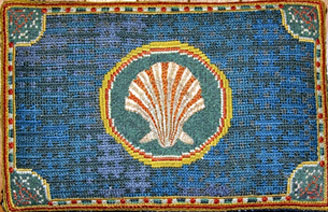
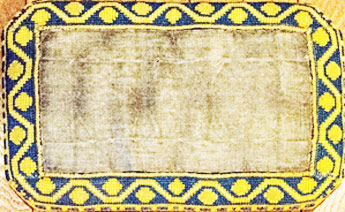
The next two images of kneelers show – first – Sybil Blunt’s tribute to the ships that serve the local economy. Next is a kneeler featuring a shell – careful and accurate but showing little of Sybil Blunt’s exuberance. Following these is Louisa Pesel’s design for the kneeler pads in the Epiphany Chapel. The cross stitch is continued on the base of the pads to add extra stiffness.